

Over the past year, we have frequently returned to one simple but uneasy question: what kind of democracy are we becoming?
We do not pose this in an abstract way, or as a political catchphrase. We raise it from lived experience in Indonesia: by observing how power works in practice, how our laws continue to evolve, and how society seeks balance when these processes begin to feel strained.
Indonesia’s democratic journey has been long and dynamic. It would be neither fair nor accurate to describe it as a failed democracy. Yet something more subtle appears to be playing beneath the surface. The substance of our democratic practice appears to be under growing pressure.
Opposition exists, but it is increasingly marginal within formal political institutions. Power is consolidated within a very broad governing coalition, leaving limited space for meaningful deliberation and principled disagreements inside the system.
This deserves attention.
Democracies do not weaken only when institutions collapse. They can also weaken when disagreements no longer have a clear and respectful place within institutions.
Many comparative accounts suggest that erosion of democratic norms is often incremental, marked by a shrinking space for meaningful contestation even as formal institutions remain in place. When this happens, criticism does not disappear. It shifts away from institutions meant to carry it.

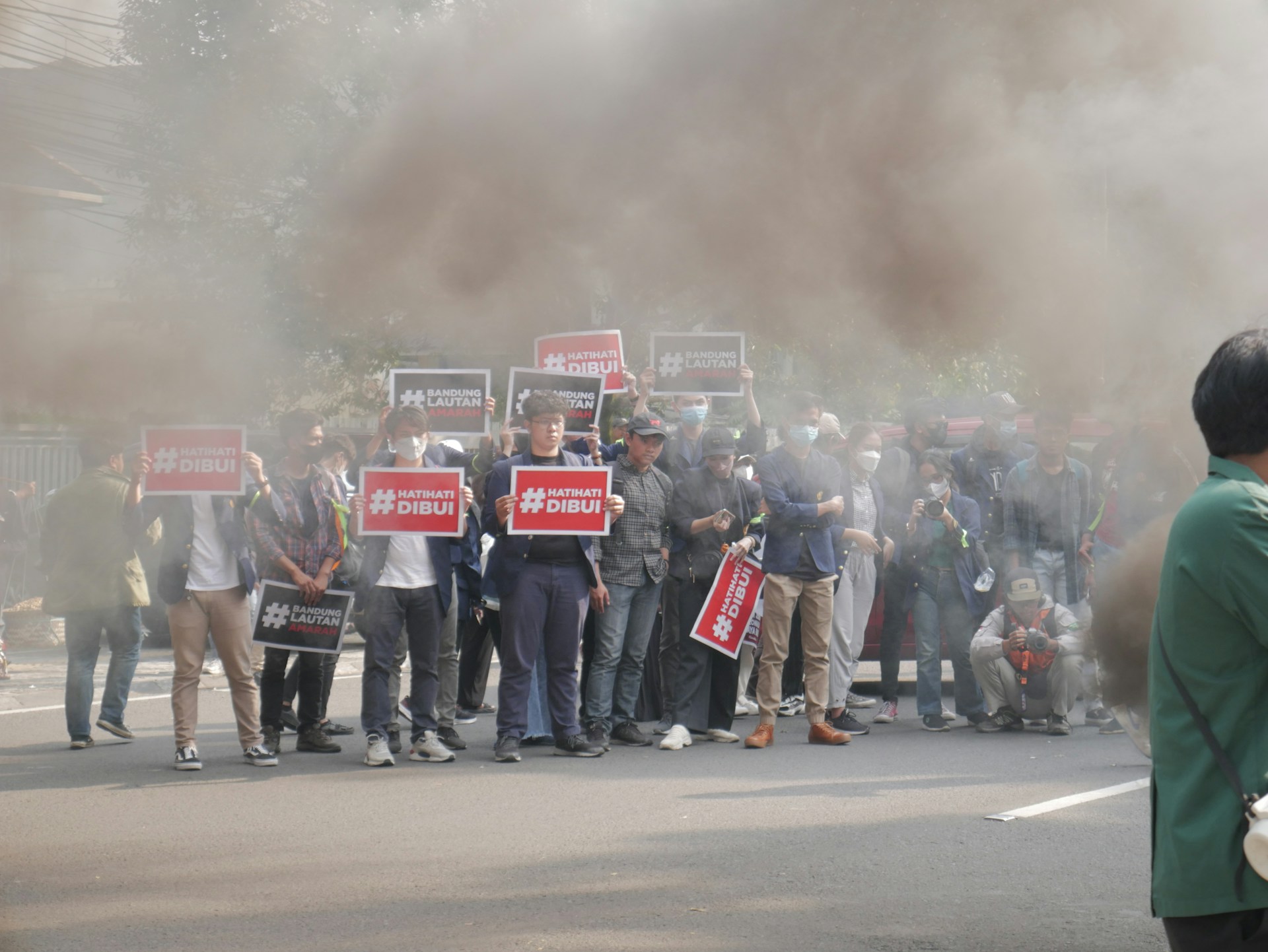
Recent public reactions—described through #PeringatanDarurat, #IndonesiaGelap, or the 17+8 protests—should be understood in this context.
They are often portrayed as emotional or disruptive. We see them as responses to a narrowing of political channels.
When opposition inside our representative bodies becomes weak or symbolic, criticisms move into civic space. Deliberation then takes place through public pressure, social media, and collective action, rather than through representative processes.
This dynamic is not unfamiliar in Indonesia.
From the earliest years of the republic, there has been an unresolved tension between the need for national unity and the need for open debate on reforms. Some of our early leaders worried that too much contestation would weaken a young nation.
Others warned that national unity without legitimate opposition would slowly drain our democracy of substance.
That debate was never fully resolved. It has resurfaced periodically in our history, often when power became too concentrated and political alternatives too narrow.
What followed, repeatedly, was a similar pattern. When institutional opposition weakened, civil society filled the gap.
Youth movements were often at the forefront, not because they sought power, but because they felt a shared responsibility to safeguard the common good when formal politics could no longer absorb disagreements.
The Sumpah Pemuda of 1928 offered an early example of this civic role. It showed that political responsibility in Indonesia has never belonged only to those who hold office, or to formal political organizations. That role reappeared in Reformasi 1998, again driven largely from outside established power, and it remains visible today, even as the forms of engagement continue to change.
What is different now is not the source of civic agency, but the medium through which it is expressed.
Much of today’s civic criticism is informal, decentralized, and amplified through social media platforms.
This adds speed, reach, and visibility to forms of engagement that have long existed.
It can feel uncomfortable and, at times, unstructured. It can also be uneven and imperfect. Yet it reflects adaptation.
When formal political space narrows, society finds other ways to express concern, seek explanation, and call for accountability.
These questions about the resilience of our democratic system are closely connected to other challenges Indonesia now faces.
Earlier this year, the Indonesian government’s decision to rely on foreign systems for managing the nation’s personal data protection are framed as technical or efficiency-driven.
Nevertheless, these kinds of decisions have profound repercussions with regards to digital sovereignty. They relate to determining who gets to set the rules, where responsibility is located, and where remedies reside in case of error. These choices shape the boundaries of rights and obligations in ways that law alone cannot easily reverse.
Natural disasters, including the recent floods in Sumatra, raise parallel concerns. They force us to confront environmental responsibility and social justice across generations.
Climate crises do not respect electoral cycles or administrative boundaries.
They test whether legal and political systems are capable of acting with foresight, restraint, and fairness, rather than short-term convenience.

Across democracy, data governance, and environmental risk, the underlying question is the same.
It concerns how we manage differences in order to preserve unity, and how we manage uncertainty without abandoning the values of deliberation. Stability achieved by narrowing debate may appear efficient in the short term. But it is also fragile. Systems endure when decisions are tested through open discussion, mutual restraint, and collective responsibility.
Deliberation and accountability are not threats to unity. They are among the conditions that allow constitutional democracy to endure.
In this annual letter, we offer these reflections with humility.
Indonesia’s democracy has always been a negotiated, imperfect, and evolving process. Periods of openness and periods of consolidation have alternated throughout our history. Nonetheless, we still hold on to hope with guarded optimism.
One of Indonesia’s enduring strengths has been its ability to absorb criticisms while maintaining unity.
Civil society, especially our younger generations, continues to act as a balancing force when formal politics falls short.
This capacity to hold together while disagreeing has never been accidental; it has been learned, practiced, and renewed across our history.
For the love of our country,
Alldo Fellix Januardy